Agriculture remains the backbone of Cambodia’s economy, employing more than one-third of the national labour force and generating over USD 3 billion in export revenue in just the first seven months of 2026. Yet the sector’s defining weakness over the past decade has also become its clearest investment opportunity for the next five: Cambodia exports the overwhelming majority of its agricultural output in raw, unprocessed form, capturing only a fraction of the value that its neighbours extract from the same crops. For investors and Cambodian businesses alike, the next five years will likely be defined by whether the country can finally convert its raw agricultural volume into processed, higher-value food and agro-industrial products — and the policy signals suggest the government is now treating this conversion as a national priority rather than an aspiration.
1. The Scale of the Opportunity: Raw Volume Without Value Capture
The scale of Cambodia’s raw-material advantage is substantial. The country is the world’s second-largest cashew producer after Côte d’Ivoire, with more than 580,000 hectares under cultivation and annual production potential exceeding 816,000 tonnes; the cashew sector alone generated over USD 1 billion in 2024, equivalent to roughly 2% of GDP. In 2025, Cambodia exported around 1 million tonnes of raw cashew nuts worth USD 1.5 billion, a 27% increase on 2024. Rice, Cambodia’s staple crop, covers 3.5 million hectares and produces 11.62 million metric tons of paddy annually, with 6.29 million metric tons of surplus production available for milling and export.
The problem is that almost none of this volume is processed domestically before export. According to the Asian Development Bank, Cambodia exports most of its raw materials, with only about 10% processed domestically. For cashews specifically, roughly 90% of the crop is exported raw and processed in neighbouring Vietnam, which captures the value-added margin that could otherwise accrue to Cambodian processors. Rice tells a similar story: Cambodia mills only about one-third of the rice it grows, exporting the majority as unmilled paddy. Industry analysis suggests that raising Cambodia’s domestic cashew processing rate alone could generate hundreds of millions of additional dollars in export value — without requiring any increase in raw agricultural output.
2. Sources of Comparative Advantage
Raw-material abundance and crop leadership
Cambodia’s comparative advantage begins with genuine agronomic strength rather than manufactured cost incentives. The country ranks among the world’s top producers of cashew and holds internationally recognized rice varieties — Phka Romdoul was named the World’s Best Rice Variety in 2022 — giving Cambodian processors a premium raw-material base that many competing processing hubs must import.
An explicit national policy shift toward processing
The Cambodian government has moved from rhetorical support for agro-processing to concrete institutional commitment. The Agri-Food Industrial Park (AIP) Framework, approved by Prime Minister Hun Manet on May 29, 2026, establishes a “Private Sector-Led and Government-Linked” model explicitly designed to accelerate industrialisation of the agricultural sector, attract quality investment, and strengthen value chains. The Council for the Development of Cambodia has formally designated agro-processing a high-priority investment sector, and specific agro-industrial parks are advancing in Kampong Thom, Battambang and Kampong Speu provinces, including a dedicated cashew-processing zone in Kampong Thom.
Investment incentives under the QIP framework
Agro-processing is explicitly included among the government’s 19 priority categories eligible for Qualified Investment Project incentives, alongside high-technology manufacturing and electronics. These incentives — extended tax holidays, customs duty exemptions on imported processing machinery, and streamlined permitting — apply directly to agricultural and food-processing investment, reducing the effective cost of building processing capacity that Cambodia currently lacks.
Diversified export base and market access
Cambodia’s agricultural exports are not narrowly concentrated. In 2024, agricultural exports reached 11.66 million tonnes and earned approximately USD 4.8 billion, spanning rice, cassava, rubber, cashew, corn, palm oil, pepper and tobacco, sold into China, the EU and ASEAN markets including Vietnam and Thailand. This diversification gives processors multiple viable crop lines to build around, rather than dependence on a single commodity, while Everything But Arms access to the EU and RCEP participation support finished or semi-processed product exports once processing capacity is built.
International development partnership
The AIP Framework has been developed with active support from the Australian government since 2022, working alongside the CDC and the Ministry of Economy and Finance. This kind of sustained bilateral technical cooperation lends institutional credibility to the framework and signals continuity of policy support beyond a single budget cycle — an important consideration for investors evaluating multi-year processing infrastructure commitments.
3. Crop-Level Opportunities for 2026–2031
| Crop / Segment | Five-Year Opportunity |
| Cashew processing | Cambodia’s single clearest agro-processing opportunity: world’s second-largest producer, ~90% still exported raw; Korea-backed and Japan-backed processing plants already under construction in Kampong Thom signal investor confidence. |
| Rice milling and premium branding | Only about one-third of paddy is milled domestically; expanding milling capacity and marketing globally recognized varieties (Phka Romdoul, Sen Kro Ob) as branded premium exports offers strong margin upside. |
| Cassava processing | Cambodia ranks among the world’s top ten cassava producers with strong Chinese, Vietnamese and Thai demand; starch and processed-cassava-product investment remains underdeveloped relative to raw exports. |
| Dried fruit and horticulture processing | Existing exports of dried mango and pineapple show proof of concept; scope to expand into broader dried-fruit, juice and horticultural processing lines for both regional and Western markets. |
| Rubber and palm oil downstream processing | Substantial raw rubber and palm oil export volumes with limited domestic downstream processing; opportunity for higher-value intermediate and finished-product manufacturing. |
| Cold-chain and food-logistics infrastructure | Explicitly identified alongside agro-processing in the government’s 2026 diversification agenda; cold-chain investment is a prerequisite enabler for higher-value perishable food processing and export. |
4. A Five-Year Outlook: 2026–2031
| Period | Expected Development |
| 2026–2027 | Framework activation. Agri-Food Industrial Park sites in Kampong Thom, Battambang and Kampong Speu move from approval to construction; early cashew-processing investment (Korea-backed and similar projects) comes online; QIP incentive uptake in agro-processing accelerates from a low base. |
| 2028–2029 | Capacity build-out. Domestic processing share for cashew and rice begins rising from the current roughly 10% baseline as AIP-linked facilities reach commercial operation; workforce-training partnerships with RUPP, ITC and international partners expand to address the technical-talent gap. |
| 2030–2031 | Value-chain maturation. A larger share of Cambodia’s agricultural export value is captured domestically rather than exported raw; branded, higher-value processed products (premium milled rice, processed cashew, cassava derivatives) become a more visible share of total agricultural exports, provided price-stabilization and capital-access constraints have been meaningfully addressed. |
5. Practical Tips for Investors
For investors and the professional-services firms supporting them, five priorities stand out for the next five years.
First, prioritize cashew and rice processing as the clearest near-term opportunities, given their combination of production scale, existing government-backed pilot projects, and the largest gap between raw export volume and domestic processing capacity.
Second, structure investment to qualify fully for Qualified Investment Project incentives under the agro-processing category, and engage directly with the Agri-Food Industrial Park Framework and CDC to access designated industrial-park sites and associated infrastructure support.
Third, build workforce-development partnerships into the investment plan from the outset, given the acute shortage of food-engineering graduates — partnering with RUPP or ITC, or investing directly in in-house technical training, will likely be necessary rather than optional.
Fourth, plan for raw-material price volatility explicitly in financial models, since the absence of a functioning price-stabilization mechanism for crops such as cashew means processors bear meaningful input-cost risk.
Fifth, engage compliance and tax advisory support early to navigate QIP qualification, customs treatment of processing machinery, and evolving agricultural export documentation requirements, particularly for exports destined to the EU under Everything But Arms preferences.
Conclusion
Cambodia’s comparative advantage in agro-processing rests on an unusually clear and quantifiable gap: the country already produces the raw agricultural volume that a competitive food-manufacturing sector would need, but currently converts less than a tenth of it into higher-value processed goods domestically. This driven by the newly approved Agri-Food Industrial Park Framework, explicit QIP-level investment incentives for agro-processing, and growing bilateral development support. The outcome, however, is not guaranteed by policy alone. Whether Cambodia captures meaningfully more of its agricultural value chain by 2031 will depend on whether workforce-training capacity, raw-material price stability, and access to capital for both foreign investors and Cambodian agribusinesses keep pace with the government’s stated ambitions — making agro-processing one of the more policy-dependent, but also one of the more clearly signposted, investment opportunities in Cambodia’s diversification agenda.
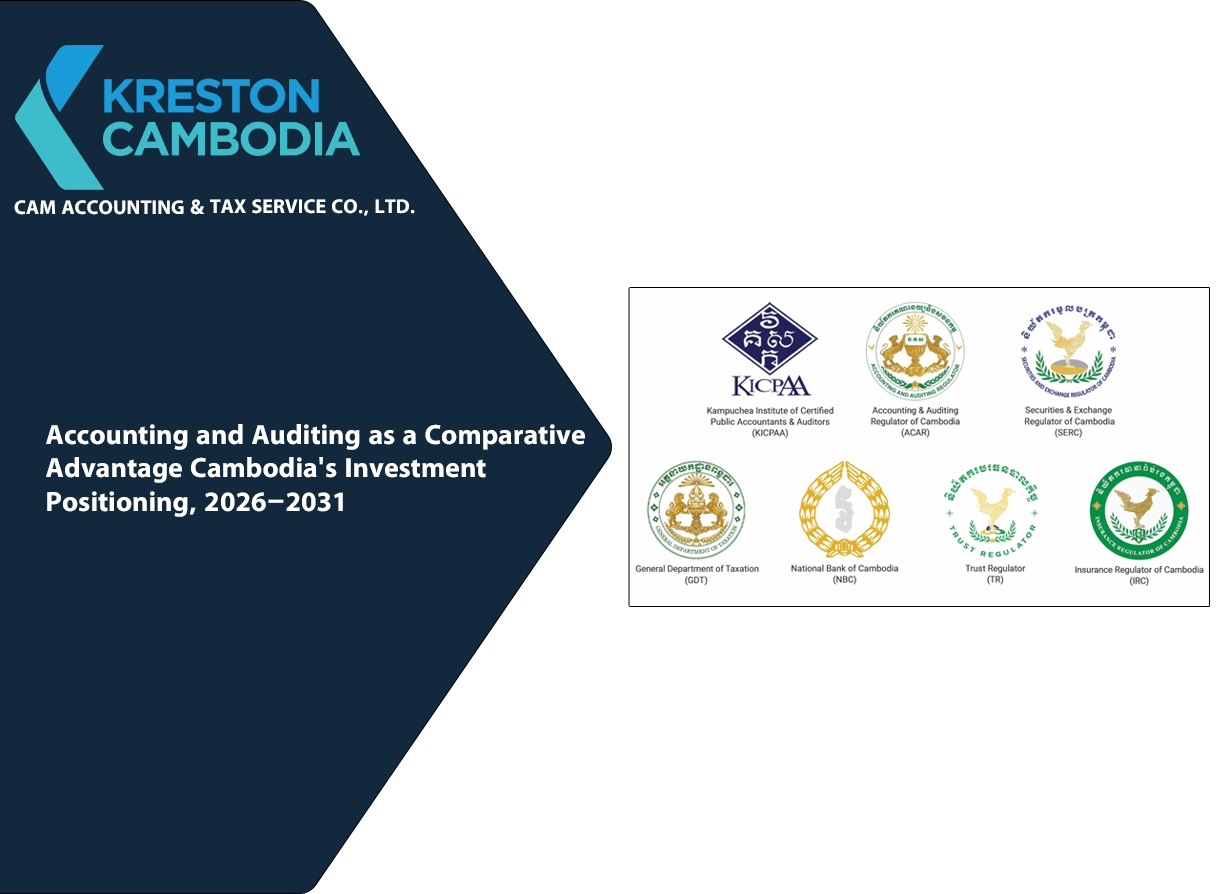
Cam Accounting & Tax Service Co., Ltd., a member firm of Kreston Global, holding a GDT tax agent license, Accounting, Auditing, and liquidator licenses from ACAR, and accredited by the National Bank of Cambodia (NBC) and Trust Regulator (TR).
For more information, please contact our Accounting, Tax and Audit Expert
Ms. Haing Sivtieng, MIPA, MBA
Partner
Chinese Line: +855 89 777 589
English line: +855 93 33 5158
Mr. Keat Heng, ACCA, CPA, FCCA
Partner
Mobile: +855 12 753 257
E-mail : info@krestoncambodia.com
Website: www.krestoncambodia.com